Why Can't a Party Admit the Other Side Is Right?

"Nobody feels like they're running blindly. Blindness feels like certainty from the inside."
This is a reflection, not a factual claim.
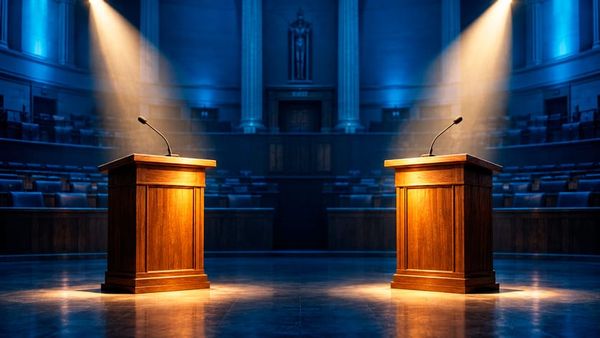
Imagine a member of parliament standing up in a plenary session and saying: "On this point, the other side's proposal is better than ours. I support it."
Does that sound believable? To most people, it doesn't. And that alone says something important about political culture, and about all of us.
Parties make compromises every day. In Finland, governments have been built for decades on cooperation between several parties, and every government programme is ultimately a collection of concessions. So cooperation works, but it can't be said out loud. The concession is made behind closed doors and defended in public as a victory.
Why is it so hard to admit publicly that the other side holds part of the truth?
When an opinion becomes an identity
We wrote earlier about three mechanisms that shape everyone's thinking: information cascades, conformity, and motivated reasoning. The last one is the most decisive for political parties. We don't judge claims only by whether they are true, but also by what they mean for the group we belong to.
A party is exactly that kind of group. It isn't just a set of policy proposals. It is a community with its own language, its own opponents, and its own idea of who "we" are. When the other side's proposal challenges something the party has committed to, it no longer feels like a question of substance. It feels like an attack.
And as we wrote before: you don't negotiate with an attack, you defend yourself against it.
In her new book Itsekkyyden aika (The Age of Selfishness), Finnish psychologist and professor emerita Liisa Keltikangas-Järvinen describes the same phenomenon at the individual level. In her view, the peculiarity of our time is that tolerance is talked about more than ever, yet instead of tolerance, "the demand for like-mindedness has increased" (translated from Finnish). According to a review of the book, a person whose self-image is fragile and borrowed from outside experiences any challenge to their values as an attack on their entire self.
The same applies to parties. The more supporters' identity rests on the idea that "we" are right and "they" are wrong, the more expensive every concession becomes.
Why a concession feels like a defeat
Parties also have structural reasons for never admitting anything:
Elections reward distinction. A party has to look different from its competitors, otherwise voters have no reason to choose it. If you admit the other side is right, you give voters a reason to vote for them.
Changing your mind looks like weakness. A politician who changes position based on new information is easily labelled a flip-flopper. Rarely does anyone praise them for listening.
Public attention rewards certainty. Uncertainty doesn't spread on social media; absolute claims do. The statement "the other side is right on this" never draws as much attention as "the other side's proposal is dangerous."
Party discipline. A parliamentary group usually votes as a bloc. An individual member who accepted another party's view would have to choose between their own judgement and their group.
None of these happen because politicians are bad people. They happen because of how the system rewards and punishes.
When the fault is always with the other side
At this point it would be easy to point at a particular party or political camp that "never listens."
The article that introduced Keltikangas-Järvinen's book did exactly that. It took the psychologist's description of a narcissistic culture and applied it to one political direction: the other side is narcissistic, our side sees clearly. The exact same description could be turned the other way, and someone surely will.
This isn't criticism of one writer. It is an example of a mechanism at work in all of us. A psychologist's description of someone who divides the world into black and white, good and evil, always seems to fit best the person who disagrees with us. And it fits even while we are reading it.
We wrote earlier about lemmings running in a herd: blindness doesn't feel like blindness from the inside. It feels like certainty. A party that is certain of its own rightness doesn't feel blind. It feels like the only one that can see.
What we lose
When parties cannot publicly accept each other's good ideas, we lose three things.
First, the best solutions. A good idea doesn't become worse because the "wrong" party proposed it. Yet it is often rejected for exactly that reason.
Second, trust. Citizens see that public debate is theatre and that decisions are made elsewhere. It erodes the belief that debate matters at all.
Third, the example. If even elected representatives can't say "I was wrong" or "you're right on this," why would anyone else dare to?
Keltikangas-Järvinen asks in her book whether individual freedom ultimately means that people have been freed from growing up. The same question can be asked of politics: being an adult means being able to hear someone who disagrees without your identity falling apart.
No party is free of this
As before: there are no people who always think for themselves and people who always run with the herd. There are only moments. The same is true of parties. Every party is sometimes able to admit that another is right, and every party sometimes fails to, because the price feels too high.
Change doesn't begin with the other side learning to listen. It begins when voters start rewarding listening. If we value the politician who says "they're right on this," that politician becomes possible. If we punish them, they become impossible.
And if a particular party that never listens came to mind while you were reading, stop at that thought once more.
The question was never about them.
When did you last give credit to a politician for admitting the other side was right?
If you'd like to ask this directly of a decision-maker, whether a representative of your own party or someone from another, you can do it on Cores.Media.
Read more: